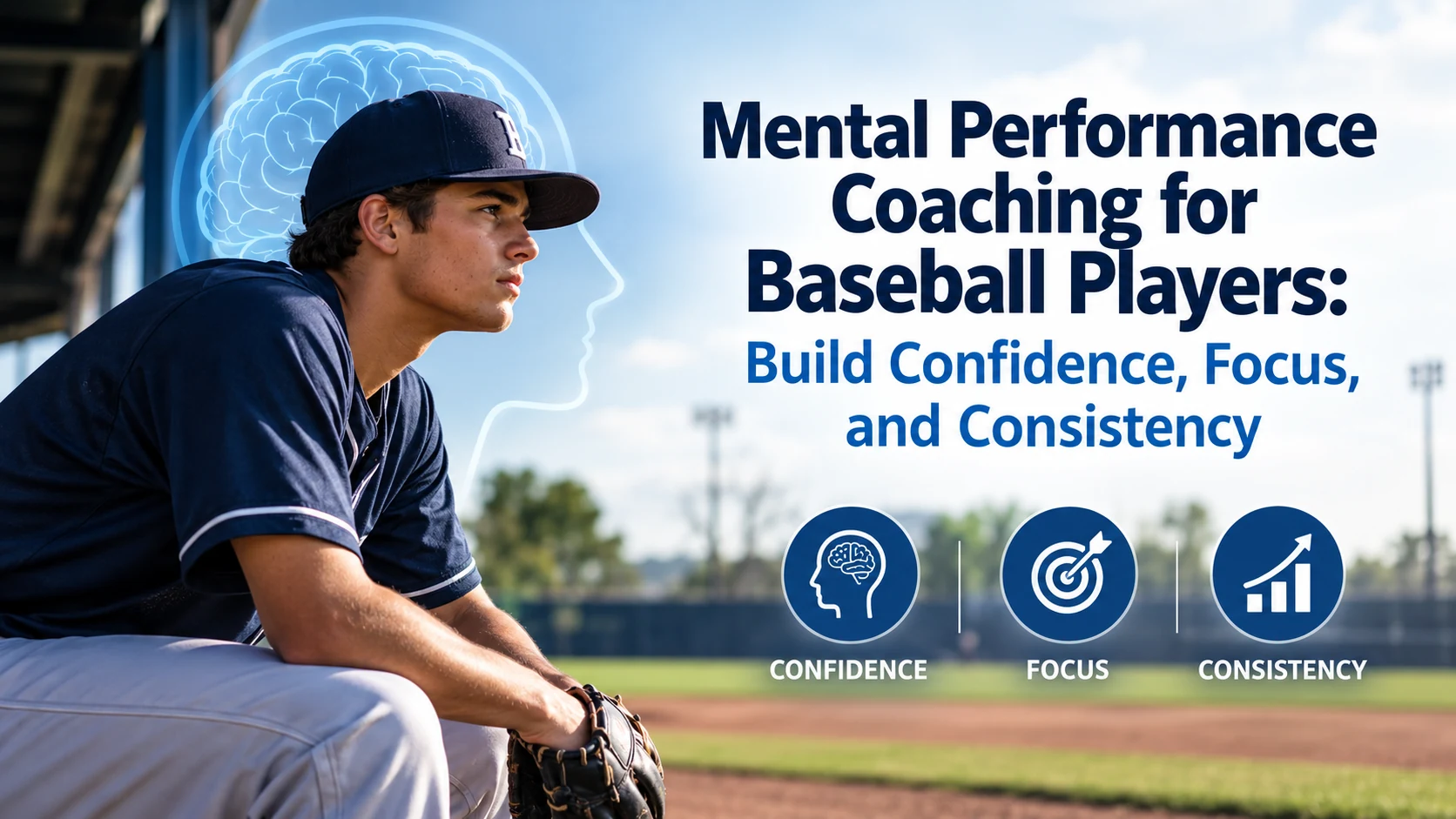
Mental Performance Coaching for Baseball Players: Build Confidence, Focus, and Consistency
Introduction:
Baseball is a game of physical skill, but physical ability alone does not always determine how a player performs. A hitter can have excellent mechanics and still struggle when the count is full. A pitcher can throw effectively in practice but lose command when the game becomes intense. A talented fielder can make routine plays during practice and then hesitate after making an early mistake.
These situations highlight the importance of the mental side of baseball.
Mental performance coaching for baseball players helps athletes develop the skills they need to stay focused, manage pressure, respond to mistakes, and perform with greater consistency. Rather than simply telling athletes to “be confident” or “stay focused,” mental performance training gives players practical strategies they can use before, during, and after competition.
Mental skills can complement physical baseball training by helping athletes apply their abilities when the pressure of competition increases.
What Is Mental Performance Coaching for Baseball Players?
Mental performance coaching is structured training designed to help athletes improve their overall skills involved in sports performance.
For baseball players, this can include:
- Developing sustainable confidence
- Improving concentration
- Managing game-day pressure
- Building productive routines
- Using visualization and imagery
- Developing effective self-talk
- Recovering from mistakes
- Setting performance goals
- Improving decision-making
- Managing distractions
- Developing emotional processing
- Preparing for competition
The goal is not to eliminate pressure or guarantee perfect performance. Instead, players learn how to respond to challenging situations in ways that support their performance.
Visualization and positive self-talk are among the mental skills commonly used by athletes. The NCAA has highlighted both techniques as strategies student-athletes can use to prepare mentally and manage distractions.
Why the Mental Game Matters in Baseball
Baseball presents a unique mental challenge because players often have significant amounts of time between important actions.
A hitter may spend several minutes waiting for an at-bat and then have only fractions of a second to react to a pitch. A pitcher may spend time on the mound thinking about the previous pitch while simultaneously preparing for the next one.
This creates opportunities for overthinking.
A player may think:
“Don’t strike out.”
“Don’t walk this batter.”
“I made that same mistake last inning.”
“I have to get a hit here.”
“What if I make another error?”
These thoughts can pull attention away from the task immediately in front of the athlete.
Mental performance training teaches players to redirect their attention toward controllable actions. Instead of focusing entirely on the result, athletes can learn to become more aware of their approach, routine, breathing, pitch selection, mechanics, or next-play objective.
USA Baseball has also highlighted the mental side of hitting, including the importance of a hitter’s thought process and approach at the plate.
Mental Performance Training for Hitters
Hitting is one of the clearest examples of why baseball mental skills matter.
Even elite hitters fail regularly. A hitter can take a great swing and still record an out. A well-struck ball can become a routine flyout, line drive, or hard ground ball.
If a player’s confidence depends entirely on the immediate result, normal baseball failure can quickly affect future at-bats.
Mental performance coaching can help hitters develop a process-based approach.
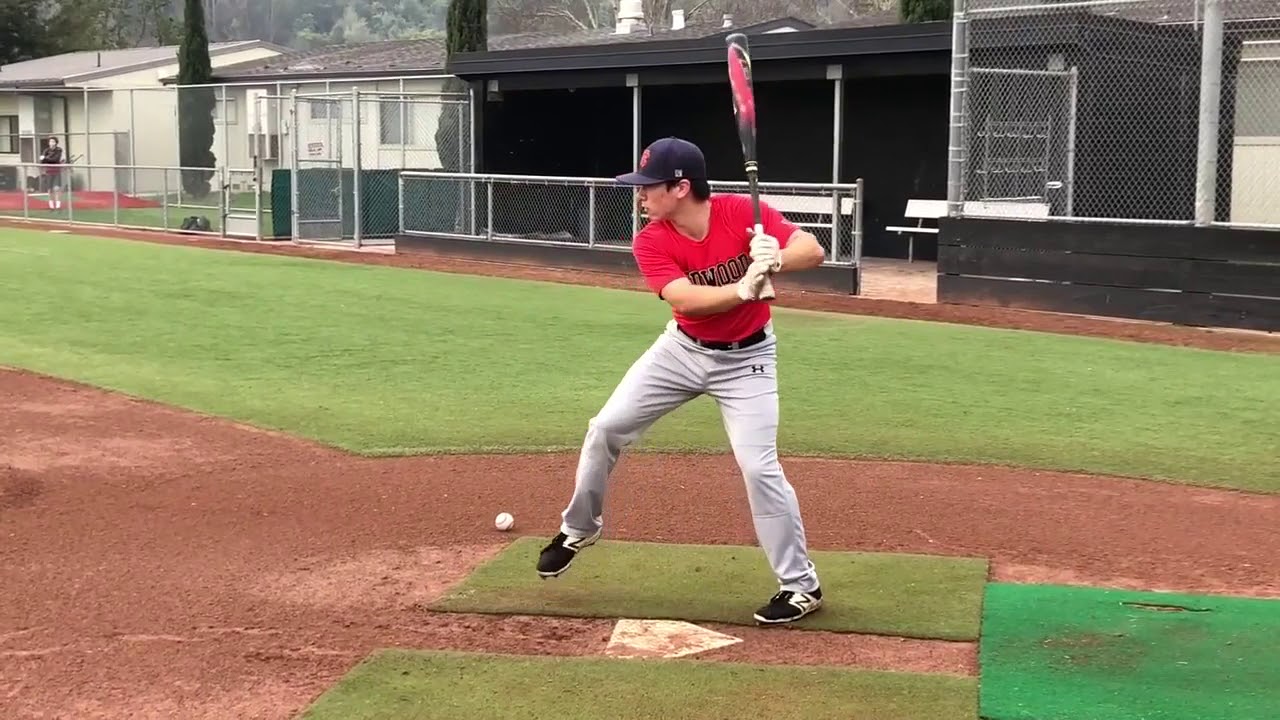
Stay Present at the Plate
A hitter cannot control whether they’re going to have a successful result. However, the hitter can control preparation, pitch recognition, approach, timing, and commitment to the pitch.
A mental performance routine might help a player move through a sequence such as:
- Step into the box.
- Take a controlled breath.
- Review the hitting approach.
- Identify the situation.
- Soft focus on the ball.
- Having the proper brain processes blended with proper intention.
- Reset after each pitch.
The exact routine can vary between athletes, but consistency can help reduce unnecessary mental noise.
Recover After a Strikeout
Strikeouts are part of baseball. The challenge is preventing one at-bat from becoming a problem in the next one.
A useful mental reset might involve acknowledging the result, identifying anything actionable, and then deliberately shifting attention toward the next opportunity.
The objective is not to pretend the strikeout did not happen. It is to prevent the previous result interfering with the next moment.
Mental Performance Coaching for Pitchers
Pitchers face a different set of mental demands.
Command, pitch selection, tempo, confidence, and the ability to respond to adversity all matter. One difficult inning can create a mental spiral if a pitcher becomes overly focused on the scoreboard or previous mistakes.
Mental performance coaching for pitchers can focus on developing a repeatable between-pitch routine.
One Pitch at a Time
The phrase “one pitch at a time” is useful only when athletes have a practical method for doing it.
A pitcher might use a routine that involves:
- Taking a breath
- Resetting posture
- Reviewing the intended pitch
- Visualizing execution
- Awareness of the target
- Delivering the pitch
- Evaluating the result briefly
- Resetting for the next pitch
This approach helps separate one pitch from another.
The pitcher cannot change the previous pitch, but can prepare for the next one.
Building Confidence in Baseball Players
Confidence is frequently discussed in baseball, but confidence is not simply something an athlete either has or does not have.
Players can develop confidence by building evidence that they can execute their skills, respond to mistakes, and handle difficult situations.
Mental performance coaching may use several strategies to support this process.
Focus on Controllables
Players cannot control umpires, opposing pitchers, weather, defensive outcomes, or the final score.
They can focus on controllable behaviors.
For example, a hitter can focus on preparation and approach. A pitcher can focus on executing the intended pitch. A fielder can focus on positioning, preparation, and making the next play.
This creates a more actionable definition of confidence.
Instead of:
“I need to get a hit.”
The player might think:
“I am prepared. See the ball. Trust my approach.”
Instead of:
“I cannot give up another run.”
The pitcher might focus on:
“Execute the next pitch.”
Developing Baseball Mental Toughness
Mental toughness is often misunderstood.
It does not mean never feeling nervous, frustrated, disappointed, or uncertain. Competitive athletes can experience all of these emotions.
Mental toughness is better understood as the ability to continue using effective strategies when circumstances become more challenging.
A mentally prepared baseball player can make an error and refocus.
A hitter can go hitless and maintain a productive approach.
A pitcher can give up a home run and prepare for the next batter.
A player can feel pressure and still execute a routine.
How Visualization Can Help Baseball Players
Visualization, sometimes called mental imagery, involves rehearsing a skill or situation in the mind.
For a baseball player, visualization might include imagining:
- Seeing a fastball clearly
- Executing a specific pitch
- Fielding a ground ball cleanly
- Making a strong throw
- Responding after an error
- Walking into the batter’s box confidently
- Executing a pre-pitch routine
- Handling a high-pressure situation
The purpose is not to predict exactly what will happen.
Instead, mental rehearsal can help players become more familiar with the actions and responses they want to use.
Visualization is particularly useful when combined with physical practice rather than used as a replacement for it. For visualization to be most affective, you must be in the Zone Motion state of mind when visualizing.
Self-Talk for Baseball Performance
Every athlete has an internal conversation.
That conversation can either support performance or add unnecessary pressure.
Negative self-talk might sound like:
“I always mess this up.”
“I can’t hit this pitcher.”
“Don’t make another error.”
Positive self-talk does not necessarily mean repeating unrealistic statements. More useful self-talk is often short, specific, and connected to the task.
Examples include:
“See it.”
“Stay balanced.”
“Trust it.”
“Next pitch.”
“Compete.”
“Stay with the process.”
The best cue depends on the player and situation.
Often there can be very faint thoughts based on certain beliefs that are undermining performance. Its important to explore those beliefs.
Handling Pressure During Baseball Games
Pressure is part of competitive baseball.
Players may feel pressure during:
- Two-out situations
- Full counts
- Bases-loaded situations
- Close games
- Playoff games
- Tryouts
- Recruiting showcases
- College competition
- Championship games
- Important at-bats
- High-leverage pitching situations
Mental performance coaching does not promise to remove pressure.
Instead, athletes can learn to recognize pressure and return their attention to a manageable task.
For example, instead of thinking about the importance of the entire game, a player can focus on the next pitch, the next defensive assignment, or the next decision.
This narrowing of attention can make challenging situations more manageable.
Processing emotions that arise from pressure is essential to achieve more consistent performance.
Recovering From Baseball Mistakes
Mistakes are unavoidable in baseball.
The difference often comes from what happens immediately afterward.
A useful reset process can include three stages:
Recognize
Acknowledge what happened without exaggerating it and observe what meaning you may give it.
Reset
Notice the disappointment and use a physical or mental cue to separate the previous play from the next one.
Refocus
Return attention to the next controllable task.
This can be particularly valuable for young baseball players who may carry one mistake through several innings.
Coaches and parents also have an important role. Creating an environment where athletes can discuss pressure and mental challenges can help normalize conversations around mental well-being.
Mental Skills Training for Youth Baseball Players
Mental performance coaching is not only for professional or college athletes.
Youth baseball players can also benefit from learning simple mental skills.
However, the approach should be age appropriate.
Young players can begin with simple concepts such as:
- Taking a breath before an important moment
- Focusing on one pitch or play
- Using a short positive cue
- Learning from mistakes
- Preparing with a consistent routine
- Setting process-based goals
- Understanding that mistakes are part of learning
The emphasis should remain on development, enjoyment, healthy competition, and learning rather than creating excessive pressure around statistics or results.
Mental Preparation Before a Baseball Game
A player’s mental preparation can begin before arriving at the field.
A simple pre-game routine might include:
Physical Preparation
Complete the normal warm-up and movement preparation required by the player and coaching staff.
Mental Preparation
Spend a few minutes visualizing key skills and situations. Use some Static State drills.
Performance Goals
Choose one or two controllable objectives.
For example:
“Stay committed to the Zone being my priority.”
“Reset quickly after every pitch.”
Breathing and Focus
Use controlled breathing and observe emotions to settle attention before competition.
Routine
Create a consistent sequence that helps transition from preparation into competition.
The goal is not to make every game identical. It is to give the athlete a familiar process to return to when distractions appear.
Mental Performance Coaching and Baseball Development
Physical baseball training develops skills such as hitting, pitching, throwing, running, and fielding.
Mental performance training addresses how athletes access those skills during competition.
These areas can work together.
A player may spend hours improving swing mechanics, but competition still requires the ability to recognize pitches, make decisions, respond to failure, and maintain attention. A player must be able to access those skills when necessary.
Similarly, a pitcher can develop excellent mechanics but still needs to access those mechanics and have strategies for responding after an error, a walk, or a difficult inning.
USA Baseball has increasingly discussed player development in terms that include decision-making, focus, readiness, and other performance factors alongside physical skills.
What Happens During Mental Performance Coaching?
The exact structure depends on the athlete and coach, but sessions may involve:
- Identifying performance challenges
- Establishing specific goals
- Developing pre-performance routines
- Practicing visualization
- Improving self-talk
- Looking at beliefs
- Learning focus strategies
- Developing mistake-recovery routines
- Preparing for high-pressure situations
- Reviewing competition experiences
- Creating individualized mental skills exercises
The objective is to turn mental skills into habits.
Just as players repeatedly practice a swing or pitch, mental skills become way more useful when they are practiced consistently rather than introduced for the first time during an important game. Neural pathways are either strengthening or weakening at all times.
Mental Performance Coaching vs. Mental Health Treatment
Mental performance coaching and mental health treatment are not the same thing.
Mental performance coaching generally focuses on performance-related skills such as concentration, routines, confidence, goal setting, and competition preparation.
Mental health concerns may require a qualified mental health professional.
The NCAA specifically distinguishes mental health care, including formal evaluation and treatment, as an area for appropriately licensed providers.
Athletes should have access to appropriate support when challenges extend beyond normal performance coaching.
Frequently Asked Questions
What is mental performance coaching in baseball?
Mental performance coaching teaches baseball players practical skills that can support concentration, confidence, preparation, decision-making, emotional control, and performance under pressure.
Can mental performance coaching improve baseball performance?
Mental performance coaching has been proven to help athletes develop strategies for handling distractions, pressure, mistakes, and competition. It works alongside physical and technical baseball training rather than replacing it.
How can baseball players improve their mental game?
Players can practice visualization, develop consistent routines, use effective self-talk, focus on controllable actions, set process-based goals, and learn how to reset after mistakes.
How do I build confidence as a baseball player?
Confidence can be developed understanding how the brain-body connection functions, by preparing consistently, practicing skills under realistic conditions, focusing on controllable actions, recognizing progress, and developing routines for handling mistakes and pressure.
How can a baseball player stay focused during a game?
Players can use Static State drills, short focus cues, breathing techniques, pre-pitch routines, and process-based goals. The objective is to repeatedly bring attention back to the current pitch, play, or responsibility.
How do baseball players deal with pressure?
Players can learn to recognize pressure without allowing it to control their attention. Breathing, visualization, routines, exploring beliefs, positive task-focused self-talk, and focusing on controllable actions can help athletes manage competitive situations.
What mental skills should baseball players practice?
Important mental skills include Static State and Dynamic Drills, proper bio mechanic integration, concentration, visualization, self-talk, goal setting, emotional regulation, confidence development, decision-making, routine development, and mistake recovery.
Is mental performance coaching useful for young baseball players?
Yes. Beginning at a young age is very beneficial for developing mental skills such as focusing on the next play, responding constructively to mistakes, preparing consistently, and using simple breathing and self-talk strategies.
What is the difference between mental toughness and mental performance?
Mental toughness generally refers to maintaining effective responses during challenging situations. Mental performance is broader and can include focus, preparation, confidence, decision-making, routines, visualization, and other skills that support athletic performance.
When should a baseball player consider working with a mental performance coach?
It’s helpful for all athletes to understand proper brain-body processes in order to consistently access their full ability. There may be times that a player may feel a greater or lesser need. Players may consider mental performance coaching when they have difficulty maintaining focus, responding to mistakes, managing competition pressure, establishing consistent routines, or transferring practice performance into games.
Build the Mental Side of Your Baseball Game
Baseball performance is more than mechanics, strength, speed, and skill. Players also need strategies for managing attention, responding to mistakes, preparing for pressure, and accessing their abilities when competition becomes challenging.
Mental performance coaching for baseball players provides a structured way to develop these skills.
Whether the goal is improving confidence at the plate, staying composed on the mound, recovering after an error, or maintaining concentration throughout a game, mental skills can become part of an athlete’s regular training routine.
The strongest approach is not to separate the mental game from baseball training. Instead, players need to develop their physical skills and mental skills together so they are better prepared to execute when the game demands it.


About Post Author