
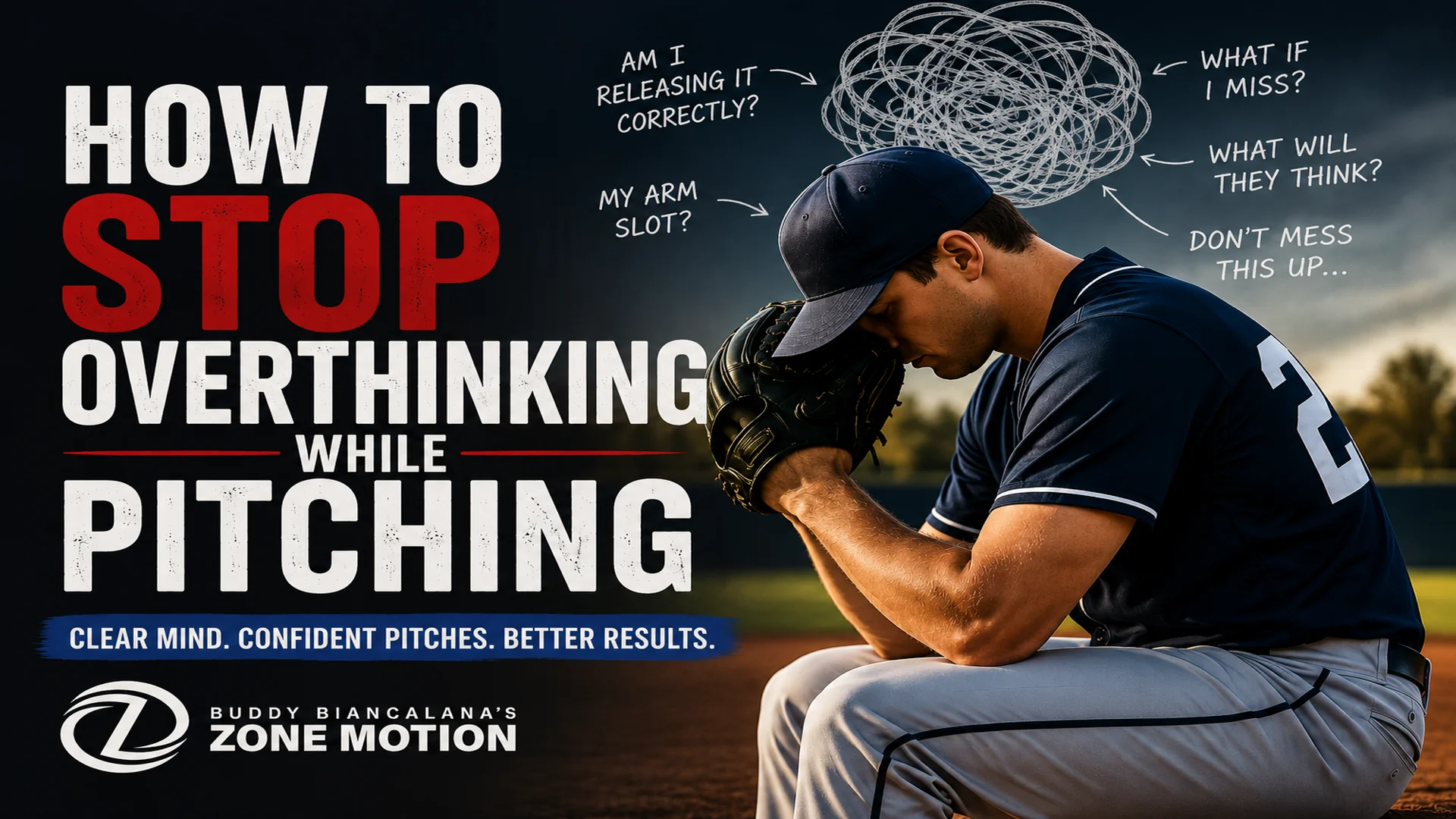
How to Stop Overthinking While Pitching
For a baseball pitcher, thinking is part of preparation. You study hitters, work on mechanics, practice pitch selection, and learn how to respond to different situations. But once you step onto the mound, too much conscious thinking can become a problem.
You may start thinking about your arm slot, release point, stride, grip, mechanics, pitch location, the runner on base, the count, or what happened on the previous pitch. Instead of reacting naturally and trusting your training, you become focused on controlling every movement.
This is overthinking while pitching.
The result can be hesitation, inconsistent mechanics, reduced confidence, slower decision-making, and difficulty staying in the present moment.
The goal isn’t to stop thinking completely. The goal is to learn when to think and when to trust your training.
Why Do Pitchers Overthink?
Overthinking often develops because a pitcher cares about the outcome and wants to control performance.
A pitcher might enter an important situation thinking:
- “I have to throw a strike.”
- “I can’t miss here.”
- “My mechanics don’t feel right.”
- “What if I give up another hit?”
- “I need to make the perfect pitch.”
- “Am I releasing the ball correctly?”
These thoughts are understandable. However, they can shift attention away from the task immediately in front of you.
Pitching involves a complex sequence of movements that has been developed through repetition. Once a movement pattern has been trained sufficiently, consciously controlling every part of it can interfere with natural execution.
This is one reason mental performance training focuses on attention, automaticity, consistency, and the ability to perform under pressure.
What Happens When a Pitcher Overthinks?
Overthinking can affect both the mental and physical sides of pitching.
1. You become focused on mechanics
Instead of focusing on the target and executing the pitch, you may start monitoring individual parts of your delivery.
You might think about your leg drive, shoulder position, arm path, release point, or follow-through while you’re actually trying to throw.
This can make the delivery feel less natural.
2. You lose your target
A pitcher needs a clear external target. When attention becomes dominated by internal thoughts, the target can become secondary.
Instead of:
See the target. Commit. Throw.
your attention becomes:
Is my arm in the right position? Did I load correctly? Is my release point right?
That shift can make execution more difficult.
3. You become trapped in the previous pitch
A bad pitch can create a cycle:
Bad pitch → analysis → worry → more analysis → next pitch
The previous pitch is already finished, but your mind continues trying to solve it.
Good pitching requires the ability to learn from mistakes without carrying them into the next delivery.
4. Pressure increases
The more importance you attach to controlling every detail, the more pressure you may feel.
A pitcher who thinks, “I have to make this perfect,” can create unnecessary tension before the pitch is even thrown.
5. Confidence becomes dependent on results
If your confidence depends entirely on whether the previous pitch was successful, it can change from pitch to pitch.
A better foundation is confidence in your preparation and ability to execute the next pitch.
The Difference Between Preparation and Overthinking
Thinking isn’t the enemy.
Preparation is valuable.
Before a pitch, a pitcher may need to consider the situation, communicate with the catcher, understand the count, identify the hitter’s tendencies, and commit to a pitch.
That’s useful thinking.
The problem begins when preparation continues into execution and you attempt to consciously control every part of the movement.
A useful distinction is:
Prepare → Commit → Execute → Reset
Rather than:
Prepare → Doubt → Analyze → Reconsider → Execute
The first process allows you to make a decision and trust it. The second keeps you mentally stuck.
How to Stop Overthinking While Pitching
1. Create a simple pre-pitch routine
A consistent routine can give your mind a repeatable process between pitches.
Your routine doesn’t need to be complicated.
For example:
- Receive or make the pitch call.
- Take a breath.
- Look at the target.
- Commit to the pitch.
- Execute.
- Reset.
The purpose isn’t to create another set of things to worry about. It’s to provide a consistent transition from thinking to performing.
2. Focus on the target
When you catch yourself thinking about mechanics during the delivery, bring your attention back to the target.
Instead of asking:
“Is my arm working correctly?”
ask:
“Where am I throwing this pitch?”
This can help shift attention from excessive internal monitoring toward the task.
3. Trust your trained movement
Pitching mechanics are developed through repetition.
You don’t need to consciously control every component of a movement that you’ve spent thousands of repetitions developing.
This doesn’t mean mechanics don’t matter. They matter enormously during training.
The key is understanding the difference between training mechanics and performing mechanics.
During practice, you can analyze movement.
During competition, the objective is to allow trained movement patterns to work.
4. Stop trying to throw the perfect pitch
A perfect pitch is an unrealistic standard.
Even elite pitchers miss their intended location.
Instead of demanding perfection, focus on executing the pitch you’ve committed to.
Your objective is not:
“I cannot miss.”
Your objective is:
“Commit to this pitch and execute.”
That distinction can dramatically change how you approach pressure situations.
5. Use a reset after every pitch
Every pitch creates an opportunity to reset.
If you throw a great pitch, don’t become distracted by celebrating it mentally.
If you throw a poor pitch, don’t spend the next 30 seconds analyzing it.
The next pitch deserves your attention.
A simple reset might involve:
Recognize → Release → Refocus
Recognize what happened.
Release the previous pitch.
Refocus on the next one.
6. Don’t let the scoreboard control your attention
A close game can naturally increase pressure.
You may start thinking about the score, the inning, the runners, the crowd, or what happens if you make a mistake.
Those factors matter strategically, but they don’t need to occupy your attention during the actual delivery.
Your attention should return to the controllable task: the next pitch.
7. Practice performing without over-controlling
Mental performance isn’t something you should only work on during games.
You can train it during practice.
For example, during bullpen sessions, introduce situations where you have to:
- follow a consistent routine
- commit to a pitch
- respond to a miss
- immediately refocus
- maintain attention under simulated pressure
This allows mental skills to become part of your normal performance rather than something you remember only when you’re struggling.
What Should a Pitcher Think About Before a Pitch?
There isn’t one thought that works for every pitcher.
However, your thoughts should generally be simple, relevant, and actionable.
Instead of thinking about five mechanical details, choose one clear intention.
That might be:
- See the target.
- Commit to the pitch.
- Attack the zone.
- Trust the delivery.
- Stay relaxed.
- Finish the pitch.
The exact cue matters less than whether it helps you perform rather than analyze.
A good performance cue should make execution simpler, not more complicated.
How to Handle a Bad Pitch
Every pitcher throws bad pitches.
The difference between a mentally strong pitcher and a pitcher who becomes trapped in overthinking is often what happens afterward.
Suppose you miss badly.
You have two choices.
You can spend the next pitch thinking:
“Why did that happen? Was my stride wrong? Did I rush? Was my arm late?”
Or you can acknowledge it and prepare for the next pitch.
If there is a genuine mechanical issue that needs to be corrected, that’s something to address during appropriate training. You don’t necessarily need to rebuild your mechanics between every pitch.
The goal is to learn without carrying the mistake forward.
How Coaches Can Help Pitchers Stop Overthinking
Coaches play an important role in developing a pitcher’s mental approach.
Constantly giving mechanical instructions immediately before every pitch can sometimes increase the amount of information a pitcher is trying to process.
Instead, coaches can help athletes develop:
- consistent routines
- simple performance cues
- clear intentions
- effective reset strategies
- confidence in trained movement
- the ability to respond constructively to mistakes
This doesn’t mean coaches should ignore mechanics. Mechanical development belongs in training.
The challenge is knowing when to analyze and when to allow the athlete to perform.
Overthinking vs. Being Mentally Prepared
These two concepts can look similar but are very different.
Mental preparation gives you clarity.
Overthinking creates uncertainty.
Mental preparation might sound like:
“Fastball away. See the target. Commit.”
Overthinking might sound like:
“Should I throw the fastball? What if he hits it? Is my arm slot right? What happened on the last pitch? Should I change my grip?”
The first creates a clear action.
The second creates hesitation.
The goal of mental performance training is not to eliminate thought. It is to help athletes develop the ability to direct attention toward what matters at the right moment.
Can Mental Training Help Pitchers Stop Overthinking?
Yes, mental training can be used to develop skills related to attention, focus, confidence, pressure management, routines, and automatic performance.
However, mental training shouldn’t be viewed as a replacement for technical coaching, physical preparation, or proper pitching development.
The strongest approach combines physical skill development with mental performance training.
For pitchers, this can mean learning how to move from deliberate practice into confident execution.
That’s where concepts such as attention, automaticity, consistency, and performance under pressure become especially relevant.
Zone Motion’s approach to sports performance training focuses on the connection between the brain, nervous system, attention, and movement. For pitchers who understand what they need to do physically but struggle to execute consistently when pressure increases, this mental side of performance can be an important part of development.
A Simple Mental Routine for Pitchers
Here’s a simple framework you can experiment with:
Before the pitch
Prepare
Understand the situation and commit to the pitch.
At the target
Focus
See your intended target clearly.
During the delivery
Trust
Allow your trained movement to happen without consciously controlling every detail.
After the pitch
Reset
Accept the result and return your attention to the next pitch.
This creates a repeatable cycle:
Prepare → Focus → Trust → Execute → Reset
The objective is not to make every pitch perfect.
The objective is to make your process consistent.
The Bigger Picture: Learning to Get Out of Your Own Way
Great pitching requires physical skill, tactical awareness, and mental control.
You need to know what you’re trying to do, but you also need to recognize when additional thinking is no longer helping.
The goal is not to have an empty mind.
It’s to have a quiet, directed mind that can focus on the task without constantly interfering with trained movement.
When you can prepare deliberately, commit confidently, execute naturally, and reset after every pitch, you give yourself a better opportunity to perform the skills you’ve already developed.
That’s an important part of learning how to perform in the zone.
Frequently Asked Questions
Why do I overthink when pitching?
Pitchers often overthink because they are trying to control their performance, avoid mistakes, or respond to pressure. Focusing too heavily on mechanics, results, or previous mistakes can make execution feel less natural.
How do I stop thinking about my mechanics while pitching?
Work on mechanics during structured practice and use a simple performance cue during competition. Rather than consciously controlling every part of your delivery, focus on a clear target and allow your trained movement pattern to execute.
How can pitchers stay calm under pressure?
A consistent pre-pitch routine, controlled breathing, a clear performance cue, and attention to the immediate task can help pitchers manage pressure. The goal is to keep attention on what can be controlled rather than the outcome.
How do I recover mentally after a bad pitch?
Acknowledge the result, avoid unnecessary analysis during the next delivery, reset your attention, and focus on the next pitch. Detailed mechanical analysis can be addressed during appropriate training.
Can mental performance training improve pitching?
Mental performance training can help athletes develop skills involving attention, focus, confidence, routines, pressure management, and consistency. It works alongside physical and technical pitching development rather than replacing it.
Should pitchers think about mechanics during a game?
Pitchers may need a simple mechanical cue when appropriate, but trying to consciously control every part of the delivery can increase mental load. Detailed mechanical work is generally better suited to practice and coaching sessions.
Train Your Mind. Improve Your Performance.
Great athletes don’t rely on physical ability alone. Building confidence, focus, decision-making, and consistency can help you perform at your best when pressure is highest. Explore sports performance training at Zone Motion and take your athletic development to the next level.
Explore Sports Performance TrainingFinal Takeaway
Overthinking doesn’t mean you’re a bad pitcher. Often, it means you’re trying too hard to control something you’ve already trained.
The solution isn’t to stop caring or stop thinking altogether.
It’s to learn when to analyze and when to trust your preparation.
Build a simple routine. Focus on the target. Commit to the pitch. Trust your trained movement. Accept the result. Then reset.
The next pitch is the one you can control.
If you’re looking to develop the mental and physical side of pitching together, explore Zone Motion’s pitching performance training and learn how its brain-body approach can help athletes develop greater consistency and confidence under pressure.


About Post Author