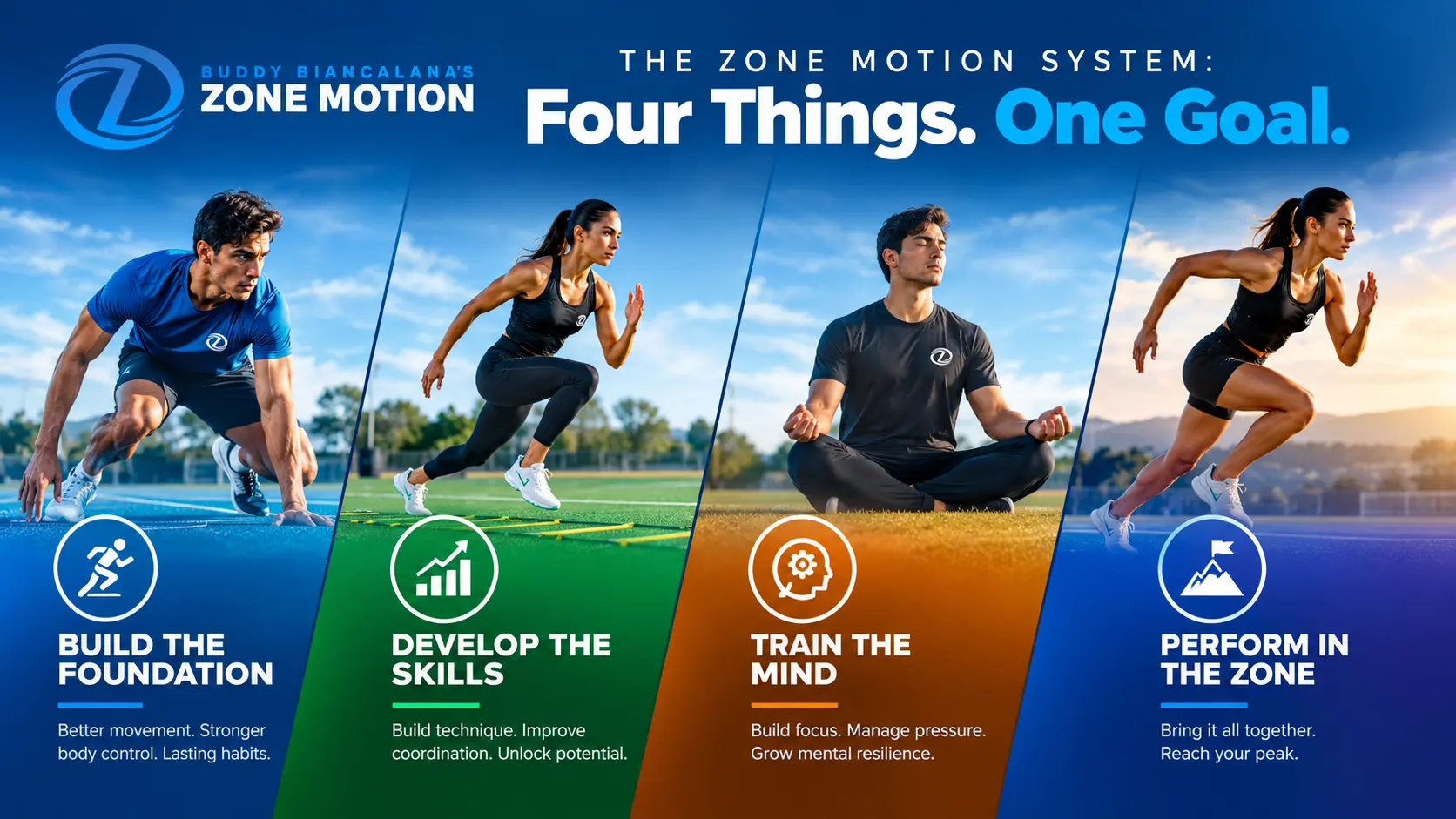
The Zone Motion System: Four Phases for Peak Performance
Peak performance is not created by talent alone. Athletes who consistently perform at their best develop physical skills, sharpen their mental approach, understand how to respond under pressure, and build habits that support long-term growth.
That is the foundation behind The Zone Motion System, a four-phase approach designed to help athletes become more complete performers.
Whether you are a baseball player trying to improve your consistency at the plate, a basketball player looking to perform better under pressure, a volleyball athlete working on confidence, or a football player trying to make better decisions during competition, athletic development involves more than simply practicing your sport.
The Zone Motion System brings together sports performance training, mental performance, skill development, and competitive preparation into a structured process.
Instead of asking athletes to chase quick fixes, the system focuses on building performance from the inside out.
What Is the Zone Motion System?
The Zone Motion System is a four-phase framework developed to help athletes understand and improve the different factors that influence performance.
The four phases are:
- Build the Foundation
- Develop the Skills
- Train the Mind
- Perform in the Zone
Each phase addresses a different part of athletic performance, but they are designed to work together.
An athlete may have excellent physical ability but struggle with confidence. Another athlete may have strong technical skills but lose focus during competition. Someone else may work hard every day but lack a structured approach to development.
The Zone Motion System recognizes that these challenges are connected.
The goal is not simply to make an athlete stronger or more skilled. It is to help athletes develop the ability to train effectively, think clearly, respond to pressure, and perform consistently.
Phase One: Build the Foundation
Every successful athlete needs a strong foundation.
Physical preparation provides the starting point for athletic development. Strength, mobility, coordination, balance, speed, movement quality, and conditioning can all influence how effectively an athlete performs.
However, foundation training is not about doing as much as possible.
Effective sports performance training should match the athlete’s age, sport, experience, goals, and current ability.
For younger athletes, this may involve developing fundamental movement skills and coordination. More experienced athletes may require more specialized strength and conditioning, speed development, power training, or sport-specific physical preparation.
A strong foundation helps athletes:
- Move efficiently
- Develop strength and power
- Improve coordination
- Build speed and agility
- Reduce avoidable movement limitations
- Handle the physical demands of competition
- Create better training habits
This phase is important because technical skills become more difficult to apply when the body cannot consistently execute the required movement.
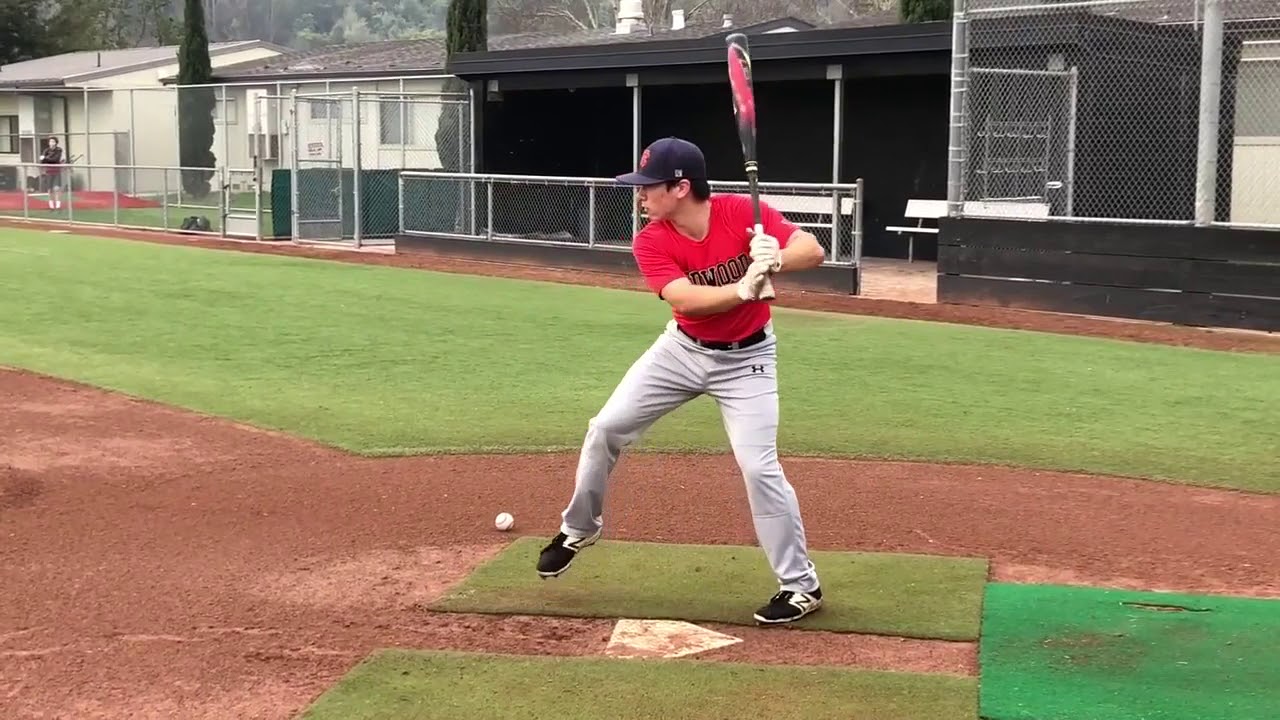
For example, a baseball player may understand how to generate power through a swing, but poor movement mechanics or inadequate physical preparation can prevent that skill from translating into consistent performance.
The same principle applies across sports.
Peak performance begins with preparation.
Phase Two: Develop the Skills
Physical ability creates potential, but athletes still need sport-specific skills to turn that potential into performance.
The second phase focuses on developing the technical and tactical abilities required by an athlete’s sport.
This is where sport-specific training becomes particularly important.
A baseball athlete may work on hitting, throwing, fielding, pitching, or base running. A basketball player may focus on shooting, ball handling, passing, footwork, and decision-making. Volleyball athletes may work on serving, passing, attacking, blocking, and defensive movement.
But skill development is not simply about repeating an action hundreds of times.
Quality matters.
Athletes need to understand what they are trying to accomplish, receive useful feedback, and gradually learn to execute skills in increasingly challenging situations.
Training should also move beyond comfortable repetition.
Competition rarely gives athletes perfect conditions. Opponents create pressure. The environment changes. Decisions have to be made quickly.
That means effective athletic skill development should eventually include situations that challenge an athlete’s reaction, awareness, decision-making, and consistency.
The objective is to help skills become reliable enough that athletes can access them when competition becomes difficult.
Phase Three: Train the Mind
One of the biggest differences between practice and competition is pressure.
An athlete can look outstanding during practice and struggle when the result suddenly matters.
Why?
Because performance is not purely physical.
Confidence, concentration, emotional control, decision-making, self-talk, and the ability to recover from mistakes can all affect athletic performance.
The third phase of the Zone Motion System focuses on the mental side of competition.
Mental performance training for athletes can help athletes understand how their thoughts and emotions influence what they do on the field, court, or course.
This does not mean trying to eliminate nerves.
Nervousness is a normal part of competition.
Instead, athletes can learn how to recognize pressure, manage their attention, reset after mistakes, and stay connected to the task in front of them.
Consider a baseball player who strikes out in an important situation.
The physical event has already happened.
The next question is what happens mentally.
Does the player continue thinking about the strikeout during the next inning?
Does confidence disappear?
Does the athlete become overly focused on avoiding another mistake?
Or can the player reset, return attention to the present moment, and approach the next opportunity with confidence?
That ability to recover is a major part of competitive performance.
Mental training can help athletes develop skills such as:
- Maintaining concentration
- Building performance confidence
- Managing competition pressure
- Developing productive self-talk
- Recovering from mistakes
- Establishing pre-performance routines
- Staying focused on controllable actions
- Preparing mentally for competition
The goal is not to make athletes think less.
It is to help them think more effectively when performance matters.
Phase Four: Perform in the Zone
The final phase brings everything together.
An athlete has developed physical capabilities. Technical skills have been refined. Mental preparation has been incorporated into training.
Now the challenge is applying those elements when it matters most.
This is where athletes begin learning what it means to perform in the zone.
The “zone” is often described as a state in which an athlete feels highly focused, confident, and fully engaged with performance.
It is important to understand that athletes cannot simply force themselves into the zone on command.
Instead, they can develop conditions that make high-level performance more repeatable.
That means trusting preparation rather than constantly trying to control every movement or outcome.
An athlete who has practiced a skill thousands of times does not need to consciously analyze every part of the movement during competition.
The focus can shift toward the situation, the opponent, the next decision, or the task.
This is where the first three phases become valuable.
Physical preparation supports execution.
Technical development creates skill.
Mental preparation supports focus and response.
Together, they create a stronger foundation for competitive performance.
Why the Four Phases Work Together
The four phases should not be viewed as separate training programs.
They are connected.
Imagine an athlete who has excellent physical conditioning but struggles to maintain concentration.
More conditioning alone may not solve the problem.
Or consider an athlete with exceptional technical ability who becomes overwhelmed during important competitions.
Additional repetitions may help, but mental preparation may be equally important.
The Zone Motion System takes a broader view of athlete development.
It asks:
Is the athlete physically prepared?
Can the athlete execute the required skills?
Can the athlete manage pressure and maintain focus?
Can the athlete bring all of these elements together during competition?
This approach can help athletes identify weaknesses that might otherwise be overlooked.
From Practice to Competition
One of the biggest goals of a structured performance system is transferring training improvements into competition.
This is where many athletes struggle.
They may perform a movement perfectly in a controlled environment but have difficulty executing it when an opponent, crowd, scoreboard, time limit, or important result is involved.
Training therefore needs progression.
Athletes should gradually move from controlled learning environments toward realistic competitive challenges.
This can include:
- Increasing decision-making demands
- Adding time pressure
- Introducing opponents
- Practicing recovery after mistakes
- Creating competitive scenarios
- Testing skills when fatigued
- Developing consistent pre-performance routines
The purpose is not to make every training session stressful.
Instead, athletes learn how to remain effective when conditions become less predictable.
That is an important part of performance training for athletes.
The Zone Motion Approach to Long-Term Athletic Development
Peak performance should not be treated as a destination.
Athletes develop over time.
Their bodies change. Their sports become more competitive. Their goals evolve. New strengths emerge, while new weaknesses become visible.
A good performance system should therefore encourage continuous learning.
The Zone Motion System is designed around that idea.
Rather than promising instant results, the four-phase approach encourages athletes to develop sustainable habits and understand their own performance.
This can be especially valuable for young athletes.
Early sports development should not be solely focused on winning today.
Athletes also need to learn how to train, how to handle setbacks, how to respond to coaching, and how to continue improving when progress becomes slower.
Those lessons can remain valuable throughout an athlete’s career.
Who Can Benefit From the Zone Motion System?
The system can be relevant to athletes at different stages of development.
Young athletes can use the framework to build fundamental physical and mental skills.
Developing athletes can use it to identify weaknesses and create more structured training habits.
Competitive athletes can use the approach to improve consistency, mental preparation, and performance under pressure.
The principles can also apply across multiple sports, including:
- Baseball
- Basketball
- Volleyball
- Football
- Golf
- Softball
Each sport requires different technical abilities, but the underlying principles of preparation, skill development, mental performance, and competitive execution remain relevant.
Peak Performance Is More Than Physical Training
Modern athletic development requires a broader perspective.
Strength training matters.
Speed matters.
Technique matters.
But so do confidence, concentration, decision-making, recovery, preparation, and the ability to respond when things do not go according to plan.
That is why the Zone Motion System is built around four connected phases rather than a single type of training.
Build the Foundation.
Develop the Skills.
Train the Mind.
Perform in the Zone.
When these elements work together, athletes have a clearer path toward becoming more prepared, adaptable, and confident competitors.
The objective is not simply to train harder.
It is to train with purpose.
Frequently Asked Questions
What is the Zone Motion System?
The Zone Motion System is a five-phase athletic development framework focused on physical, emotional and mental performance, for competitive execution.
What are the five phases of the Zone Motion System?
The five phases are Lifestyle Habits, Static State Training, Dynamic Drills, Bio Mechanical Integration and off field/court maintenance. Each phase addresses an important part of athlete development.
Is the Zone Motion System only for professional athletes?
No. The principles are useful for athletes at all levels, from developing young athletes to more experienced competitive performers.
Does mental performance training really help athletes?
Mental preparation can help athletes develop skills related to concentration, confidence, handling pressure, resetting after mistakes, and maintaining focus during competition. The training is supported by research.
What sports can use the Zone Motion approach?
The principles can be applied across all sports, including baseball, basketball, volleyball, football, golf, and softball. Training should still be adapted to the specific demands of each sport. Athletes in over 20 sports have been trained in the Zone Motion System.
How does sports performance training improve athletic performance?
A properly structured program can develop qualities such as strength, speed, coordination, mobility, power, and conditioning while helping athletes prepare for the physical demands of their sport.
Can the Zone Motion System help athletes perform better under pressure?
The system includes mental performance and competitive preparation, which can help athletes develop strategies for maintaining focus, managing pressure, and naturally responding constructively to what a situation requires.
How long does it take to see results from athletic training?
Results vary depending on the athlete, training consistency, starting point, commitment level, age, and program design. Sustainable athletic development generally requires consistent training over time rather than expecting immediate changes. However, an athlete will very quickly recognize that what they are learning is essential for developing and accessing their best ability. They do not need to be “sold’ on it.
Take the Next Step With Zone Motion
Peak performance does not happen by accident.
It is built through preparation, deliberate practice, mental training, commitment and the ability to apply those skills when competition demands your best.
The Zone Motion System provides a structured way to approach that development.
If you are ready to improve your physical preparation, develop your sport-specific skills, strengthen your mental game, and become a more complete athlete, explore the Zone Motion sports performance programs and courses to find the right next step for your development.
Train with purpose. Develop your skills. Strengthen your mindset. Perform in the zone.


About Post Author