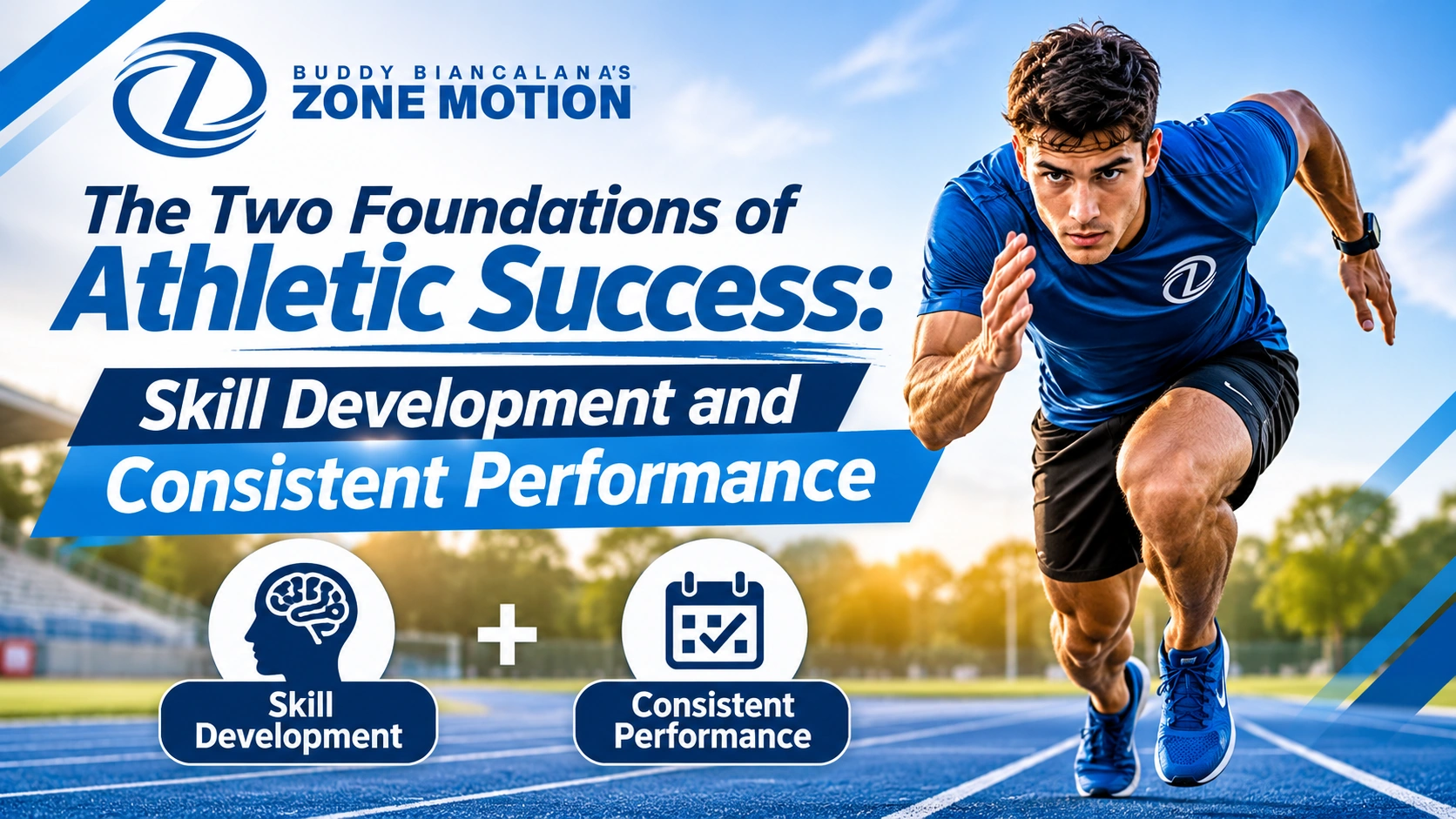
The Two Foundations of Athletic Success: Skill Development and Consistent Performance
Introduction:
Athletic success is often measured by wins, records, statistics, and individual achievements. However, behind every successful athlete is a combination of skills, preparation, physical ability, and the capacity to perform consistently under pressure.
Across almost every sport, athletes face two fundamental challenges that influence their performance: not having developed the skills they need, or not being able to consistently access the skills they already possess.
These challenges may appear similar, but they require different approaches to training and performance improvement.
An athlete who struggles with shooting accuracy, throwing mechanics, balance, or movement patterns may need additional skill development. Another athlete may demonstrate excellent abilities during practice but struggle to reproduce those same results during competition. In that case, the issue may not be a lack of skill but an inability to consistently access existing abilities.
Understanding this distinction is essential for athletes, coaches, and sports performance professionals who want to improve athletic performance and build long-term success.
1. Skill Development: Building the Abilities Required for Success
The first foundation of athletic success is skill development.
Every sport requires a specific combination of physical, technical, and cognitive abilities. Athletes must develop these abilities through structured practice, repetition, feedback, and purposeful training.
For example, a basketball player needs shooting accuracy, ball handling, footwork, coordination, and decision-making. A baseball pitcher requires proper mechanics, control, velocity, and the ability to execute different pitches. A golfer must develop swing mechanics, balance, timing, and distance control.
When these abilities are not sufficiently developed, an athlete may struggle to meet the demands of their sport.
Why Skill Development Matters
Skill development creates the foundation upon which athletic performance is built.
Without adequate technical ability, athletes may find it difficult to execute movements efficiently, respond to changing situations, or perform at a competitive level.
Effective sports skill development involves several important elements:
- Technical training: Improving the mechanics and execution of sport-specific movements.
- Repetition and practice: Reinforcing movement patterns through purposeful repetition.
- Physical conditioning: Developing strength, mobility, balance, speed, and endurance.
- Coordination: Improving the relationship between the brain, nervous system, and muscles.
- Decision-making: Developing the ability to recognize situations and respond appropriately.
However, simply practicing more does not always guarantee improvement. The quality of practice matters just as much as the quantity.
Athletes benefit from structured training that identifies weaknesses, provides meaningful feedback, and gradually increases the complexity of performance demands.
Identifying Skill Development Gaps
Coaches and athletes should first identify whether a performance problem is caused by an undeveloped ability.
Some common indicators include:
- Difficulty executing fundamental techniques.
- Repeated mechanical errors during practice and competition.
- Limited coordination or movement efficiency.
- Inconsistent technical understanding of sport-specific movements.
- Difficulty performing skills at the required competitive level.
When these issues are present, the priority should be developing the underlying ability rather than simply demanding better results.
2. Performance Consistency: Learning to Access Existing Abilities
The second foundation of athletic success is performance consistency.
An athlete can possess excellent technical skills, physical conditioning, and sport-specific knowledge but still struggle to demonstrate those abilities consistently.
Consider a baseball pitcher who regularly throws well during practice but loses command during games. Or a basketball player who makes difficult shots during training sessions but struggles to maintain shooting accuracy in competitive situations.
In these examples, the athlete may already possess the necessary skills. The challenge is accessing those abilities reliably when the demands of competition increase.
This is an important distinction because inconsistent performance does not automatically mean an athlete needs more technical training.
What Affects Performance Consistency?
Athletic performance is influenced by more than physical ability.
Several factors can affect an athlete’s ability to access their existing skills:
1. Nervous System Regulation
The nervous system plays an important role in movement, coordination, timing, and muscular control. An athlete’s ability to regulate their response to different demands can influence how efficiently they execute movements.
2. Stress and Competitive Pressure
Competition introduces pressure that may affect attention, decision-making, breathing, and movement execution. Athletes who perform well in practice may experience difficulty maintaining their usual performance when the stakes increase.
3. Fatigue and Recovery
Physical and mental fatigue can influence coordination, reaction time, concentration, and movement quality. Inadequate recovery may make it more difficult to reproduce established performance patterns.
4. Attention and Focus
Athletes must process information, recognize opportunities, and make decisions quickly. Distractions or excessive conscious control over familiar movements can interfere with execution.
5. Movement Adaptability
Sports rarely take place in perfectly controlled environments. Athletes must adapt to changing positions, speeds, opponents, and environmental conditions. The ability to maintain effective movement under changing demands is essential for consistent performance.
Why Practice Performance Does Not Always Transfer to Competition
One of the biggest challenges in sports is the gap between training performance and competitive performance.
During practice, athletes often operate in familiar and predictable environments. They may repeat the same movements, work with the same equipment, and follow established routines.
Competition introduces additional variables, including opponents, pressure, unpredictability, and changing physical demands.
An athlete may have mastered a movement in a controlled environment but struggle to reproduce it when the environment becomes more demanding.
This is why effective athletic development should extend beyond learning individual skills. Athletes must also learn to apply those skills under different conditions.
3. Understanding the Difference Between Development and Access
Although skill development and performance consistency are closely connected, they are not the same problem.
Understanding the difference helps coaches create more effective training programs and avoid spending time addressing the wrong issue.
| Skill Development | Performance Consistency |
| The athlete has not fully developed a required ability. | The athlete has an ability but struggles to access it consistently. |
| Focuses on learning and improving skills. | Focuses on reproducing skills under different conditions. |
| Requires technical practice and purposeful repetition. | Requires adaptability, regulation, and performance preparation. |
| Measures improvement in the underlying ability. | Measures reliable execution across different situations. |
For example, imagine two basketball players who struggle with shooting accuracy.
The first player has incorrect shooting mechanics and struggles to maintain proper technique. This athlete needs additional skill development.
The second player demonstrates excellent shooting mechanics during practice but becomes inconsistent during games. This athlete may need to work on competitive preparation, adaptability, attention, and performance regulation.
Giving both athletes the same training program may not produce the best results.
The first needs to improve the skill itself. The second needs to improve the ability to access that skill consistently.
4. How Athletes Can Improve Both Foundations
Long-term athletic success requires more than developing technical skills or focusing exclusively on consistency. Athletes need a training approach that supports both.
Build Strong Technical Foundations
Athletes should establish the fundamental movements and technical abilities required by their sport.
This includes identifying weaknesses, improving mechanics, and developing efficient movement patterns.
Coaches should use appropriate assessments, structured drills, and feedback to measure progress.
Introduce Variable Training Conditions
Once athletes develop fundamental skills, training should gradually introduce different conditions.
For example, basketball players can practice shooting from different positions and under varying levels of defensive pressure. Baseball pitchers can work on executing pitches in different counts and game situations.
The objective is to help athletes apply their abilities beyond predictable practice environments.
Develop Physical and Movement Capacity
Strength, mobility, coordination, balance, and conditioning contribute to an athlete’s ability to perform sport-specific movements.
A well-designed athletic development program should consider how these physical qualities support the demands of the athlete’s sport.
Improve Recovery and Preparation
Consistent performance also depends on preparation outside training sessions.
Adequate sleep, appropriate nutrition, recovery strategies, and training-load management all contribute to maintaining physical and cognitive readiness.
Train for Adaptability
Athletes must be prepared to respond to unexpected situations.
Training that includes changing movement demands, different starting positions, reactive drills, and sport-specific challenges can help athletes develop greater adaptability.
The objective is not simply to perform a movement correctly once. It is to develop the capacity to execute it effectively across different situations.
5. The Role of Zone Motion in Athletic Development
At Zone Motion, athletic development can be understood through a broader approach that goes beyond traditional skill repetition.
Athletes need to develop their physical abilities while also improving how they access and apply those abilities during performance.
This perspective connects several important areas of development:
- Static State Training: Developing awareness, control, and the ability to establish effective physical and mental states.
- Dynamic Drills: Improving movement, coordination, responsiveness, and adaptability through active training.
- Integration: Connecting individual physical and technical abilities into coordinated, sport-specific performance.
- Maintenance: Supporting continued development through away from practice and competition brain-body training.
These areas provide a framework for understanding how different aspects of athletic development can work together.
The objective is to help athletes build the skills required by their sport and improve their ability to access those skills when performance matters most.
Athletic success is not determined by what an athlete can accomplish under ideal conditions alone. It also depends on how effectively they can reproduce those abilities when circumstances change.
6. A Better Way to Evaluate Athletic Performance
When an athlete experiences performance difficulties, the first question should not automatically be how much more training they need.
Instead, coaches should identify the underlying reason for the problem.
Is the athlete missing a fundamental skill? Or do they already possess that skill but struggle to access it consistently?
This distinction can change the entire direction of a training program.
A useful evaluation process includes:
- Identify the performance problem: Determine which specific skill or performance outcome needs improvement.
- Assess the underlying ability: Establish whether the athlete has developed the necessary technical and physical foundations.
- Evaluate consistency: Compare performance across practice, training variations, and competitive situations.
- Identify contributing factors: Consider physical fatigue, recovery, attention, stress, and environmental demands.
- Develop a targeted training approach: Address the actual limitation rather than applying the same solution to every athlete.
- Measure progress: Track both skill improvement and the ability to reproduce performance consistently.
This approach allows athletes and coaches to make more informed decisions about training priorities.
Conclusion: Athletic Success Requires Both Development and Access
Athletic performance is built on two essential foundations: developing the abilities required for success and consistently accessing those abilities when they are needed.
Skill development helps athletes build the technical and physical capabilities necessary to compete. Performance consistency helps them reproduce those capabilities across different environments, challenges, and competitive situations.
Neither foundation should be overlooked.
An athlete who develops excellent skills but cannot consistently access them may struggle to reach their potential. Similarly, an athlete who performs consistently but lacks the necessary technical foundation may eventually reach a performance ceiling.
The goal of effective athletic development is to address both.
By understanding the difference between skill development and performance consistency, athletes and coaches can identify performance limitations more accurately, create targeted training strategies, and build a stronger foundation for long-term athletic success.
The question is not only what an athlete can do. It is whether they can consistently access what they have developed when it matters most.
Frequently Asked Questions (FAQs)
1. What are the two biggest challenges athletes face?
The two major challenges are insufficient skill development and inconsistent access to existing abilities. The first involves building the technical and physical skills required by a sport, while the second involves reproducing those skills reliably during different performance situations.
2. What is the difference between athletic development and performance consistency?
Athletic development focuses on improving an athlete’s physical, technical, and movement capabilities. Performance consistency focuses on the ability to access and reproduce those capabilities reliably during practice and competition.
3. Why do athletes perform better in practice than in competition?
Competition introduces additional demands, including pressure, fatigue, distractions, opponents, and unpredictable situations. These factors can affect attention, decision-making, and movement execution, even when an athlete has developed the necessary skills.
4. How can athletes improve performance consistency?
Athletes can work on performance consistency through variable training conditions, sport-specific practice, physical conditioning, appropriate recovery, preparation routines, and exercises that develop adaptability under changing demands.
5. Does more practice always improve athletic performance?
No. Practice quality, structure, feedback, and relevance are important. Repeating an incorrect movement pattern may reinforce mistakes. Purposeful practice should target specific weaknesses and provide opportunities to apply skills in different situations.
6. How does the nervous system influence athletic performance?
The nervous system coordinates movement, timing, muscular activity, and responses to sensory information. Its interaction with attention, fatigue, and stress can influence how effectively an athlete executes learned skills.
7. Why is adaptability important in sports?
Sports involve constantly changing conditions. Adaptability allows athletes to adjust their movements, decisions, and responses when faced with different opponents, positions, speeds, and competitive demands.
8. How does Zone Motion approach athletic development?
Zone Motion emphasizes a broader approach to athletic development through Static State Training, Dynamic Drills, Integration, and Maintenance. These areas help connect physical development, movement skills, adaptability, and ongoing performance preparation.


About Post Author